

You froze your eggs to give your future self more options. Then life moved on, quite literally. A new job in London, a partner in Toronto, a return home to Tel Aviv. Now a practical question sits on top of an emotional one: what happens to your frozen eggs when you move to another country?
The good news: your eggs can move with you. Frozen eggs can be transported internationally between fertility clinics and storage facilities, and many people do exactly that every year. The key is planning the move as carefully as you planned the freezing itself. This guide walks you through how it works, what to prepare, and the questions worth asking before anyone touches the tank.
Can frozen eggs really be moved to another country?
Yes. Vitrified (flash-frozen) eggs are stored in liquid nitrogen at around -196°C, and as long as they stay at that temperature, they can be safely transported. What matters is not the distance, but how well the cold chain and the chain of custody are protected along the way.
In practice, an international move involves three parties working together: your current clinic or storage facility, your new clinic abroad, and the courier who carries the eggs between them. When those three are coordinated, the move itself is usually the simplest part.
Step 1: Choose your new clinic before you book anything
Your eggs need a destination that has formally agreed to receive and store them. Before you arrange transport, confirm with the receiving clinic that:
- They accept frozen eggs from outside the country, and from your current clinic specifically
- They can store eggs frozen with your clinic’s freezing method (most clinics today use vitrification)
- They know which documents they will need from you and from your current clinic
- Their storage fees, contracts and consent forms are clear to you in advance
Every country has its own rules for importing reproductive material, and requirements can change. Your receiving clinic is usually the best first source on local rules, and an experienced fertility courier can help you understand what each side needs.
Step 2: Gather the paperwork early
Paperwork is where most delays happen. Expect to deal with some combination of:
- Release forms from your current clinic authorizing the eggs to leave their facility
- Acceptance or consent forms from the receiving clinic
- Medical and identification records linked to the stored eggs
- Import permits or customs documentation, depending on the countries involved
Start this process as soon as you know you are moving. Clinics process requests at their own pace, and a missing signature can push a transfer back by weeks. If you want to understand what can go wrong at the border, our article on how to prevent IVF shipping customs problems covers the most common pitfalls.
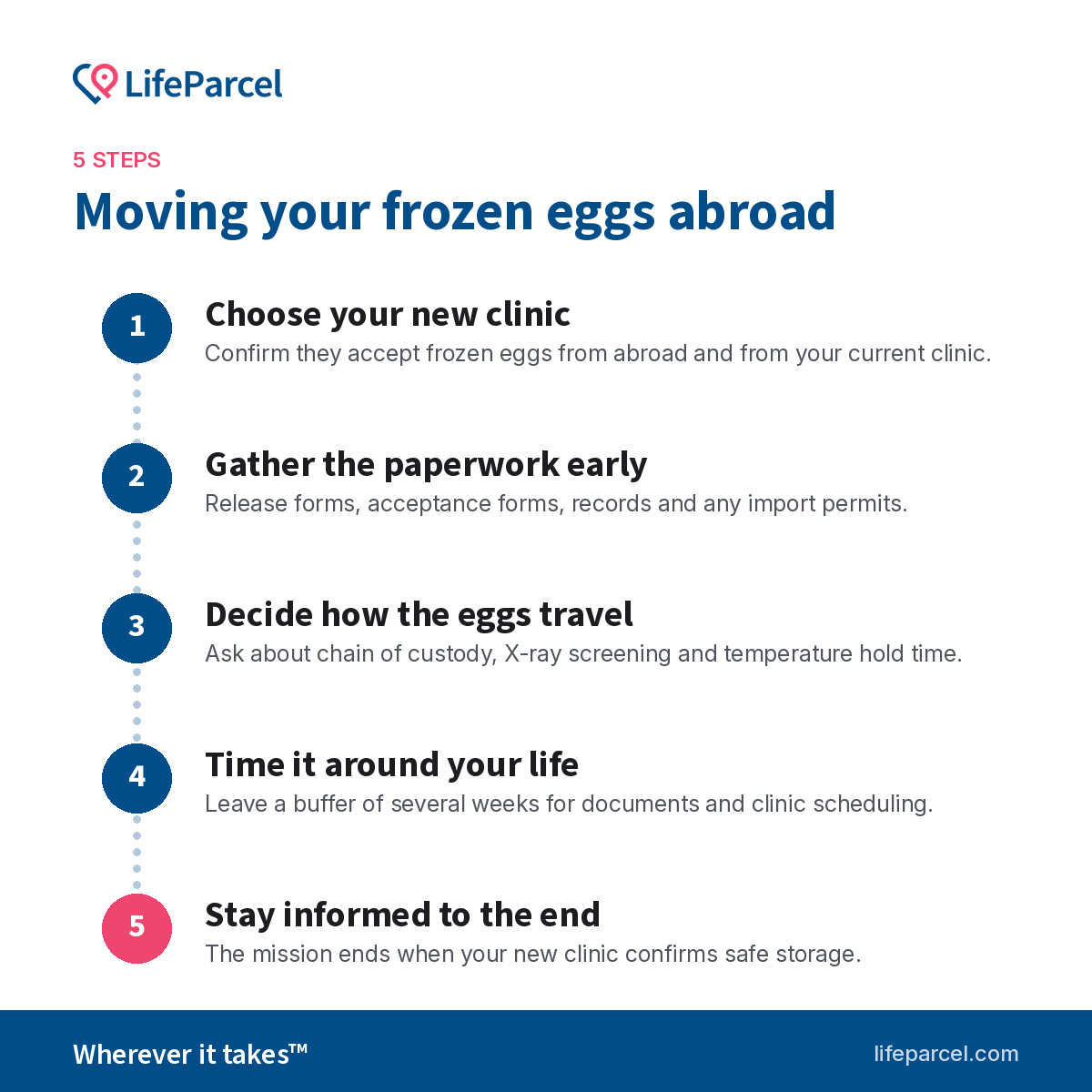
Step 3: Decide how your eggs will travel
This is the decision that matters most. Broadly, there are two ways frozen eggs travel internationally:
Commercial cryoshipping. Your tank travels as cargo through a standard logistics network, changing hands at several points along the route. It can work, but you have limited visibility into who is handling your tank, where it is, and what happens if there is a delay.
Hand-carry courier. A dedicated courier personally carries the tank from your current clinic to your new one, and never lets it out of sight. This is how LifeParcel works. Every mission has one courier, one tank, and one unbroken chain of custody from pickup to delivery. You can read more about why that matters in what actually happens to your specimens during transport.
Whichever option you consider, two technical questions are worth asking directly:
- Will the tank be X-rayed? Airport screening is a real concern for fertility material. Here is what happens when fertility specimens are X-rayed, and why LifeParcel’s couriers make sure they are not.
- How long can the tank hold temperature? LifeParcel’s medical-grade cryoshippers maintain -196°C for up to 21 days, far longer than a typical 3–4 day mission, with 24/7 data loggers recording the temperature throughout. For more on timing, see how long eggs, sperm and embryos can stay safe in transit.
Step 4: Time the move around your life, not the other way around
Your eggs do not have to travel the same week you do. Many people move first, settle in, choose a clinic, and arrange the transfer once the paperwork is ready. Others prefer to move the eggs before they leave, so everything is in one place from day one. Both approaches are valid.
What you want to avoid is a rushed transfer squeezed between packing boxes and a flight. Give yourself a buffer of several weeks for documents and clinic scheduling, and let your courier plan the route around clinic opening hours on both ends.
Step 5: Stay informed until the eggs are safely stored
The transfer is not finished when the courier lands. It is finished when your new clinic confirms the eggs have been received and placed in storage. A good courier keeps you updated at every milestone, from pickup to handover, so you are never left wondering. At LifeParcel, every client has a dedicated concierge who stays in contact with the courier throughout the mission and keeps you informed along the way.
Why people choose LifeParcel for international egg transport
LifeParcel was founded by Aharon Peretz, a senior embryologist with more than two decades of IVF clinic experience. That means the people planning your mission understand the science, not just the logistics. Our couriers have completed more than 2,500 missions across 32+ countries, working with 150+ partner clinics worldwide.
- A dedicated, vetted courier with your eggs from pickup to delivery
- Medical-grade cryoshippers holding -196°C for up to 21 days
- 24/7 temperature monitoring with real-time data loggers
- No X-ray exposure
- Support with permits, paperwork and customs clearance
- A dedicated concierge, available around the clock
Cold in our tanks, never in our approach. Wherever it takes.™
Frequently asked questions
Can I take my frozen eggs with me on the plane myself?
Some people consider it, but transporting a cryogenic tank yourself means handling airport security, customs, documentation and temperature monitoring on your own, often while you are also relocating. A professional courier removes that pressure and reduces the risk of mistakes at critical moments. See how LifeParcel’s process works.
How long does it take to move frozen eggs to another country?
The physical journey of a typical LifeParcel mission takes 3–4 days. Preparing the paperwork and coordinating both clinics usually takes longer, so it is best to start several weeks in advance.
Will moving my eggs affect their quality?
As long as the eggs stay at stable cryogenic temperature and are handled correctly, the journey itself is designed to keep them in the same frozen state they were stored in. That is why temperature monitoring and an unbroken chain of custody matter so much. If you have questions about your specific eggs, your fertility specialist is the right person to ask.
Do I need to move my eggs right away when I relocate?
No. Your eggs can stay in storage at your current clinic while you settle in, as long as your storage agreement remains active. Many people transfer them later, once they have chosen a clinic in their new country.
Who arranges the paperwork?
Both clinics will have their own forms, and some countries require import documentation. LifeParcel helps coordinate permits, paperwork and customs requirements, so you are not left to navigate it alone.
Planning a move? Let’s plan your eggs’ journey too
Tell us where your eggs are now and where they need to go, and we will prepare a personalized plan for your mission. Request a quote and a member of our team will be in touch.