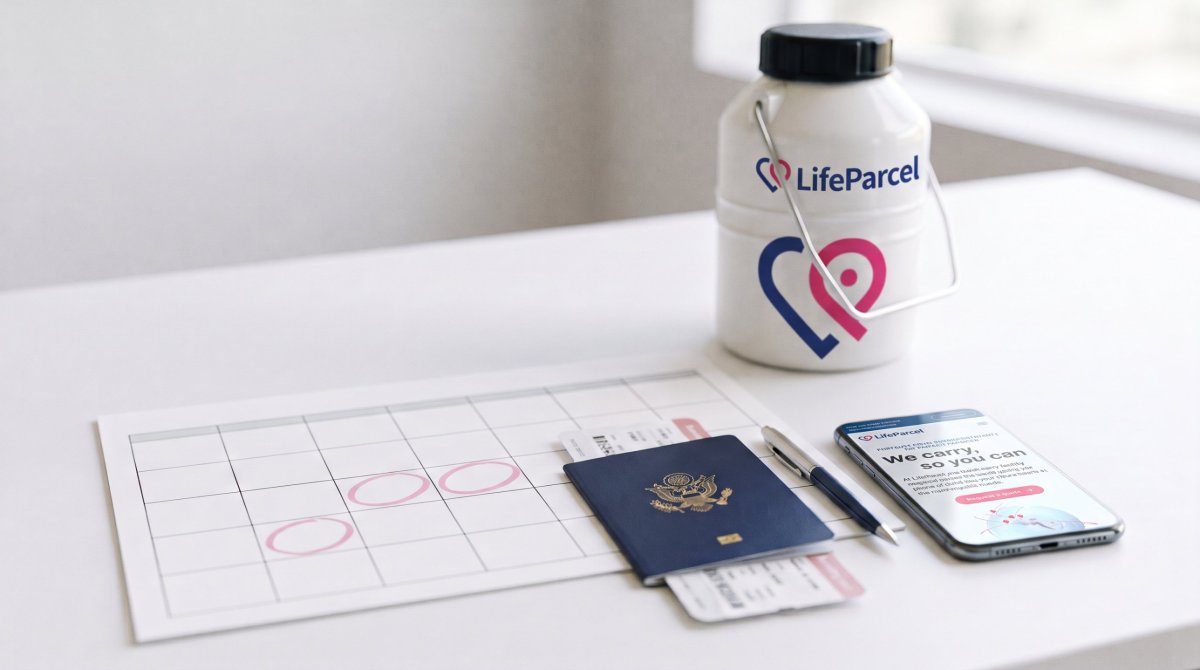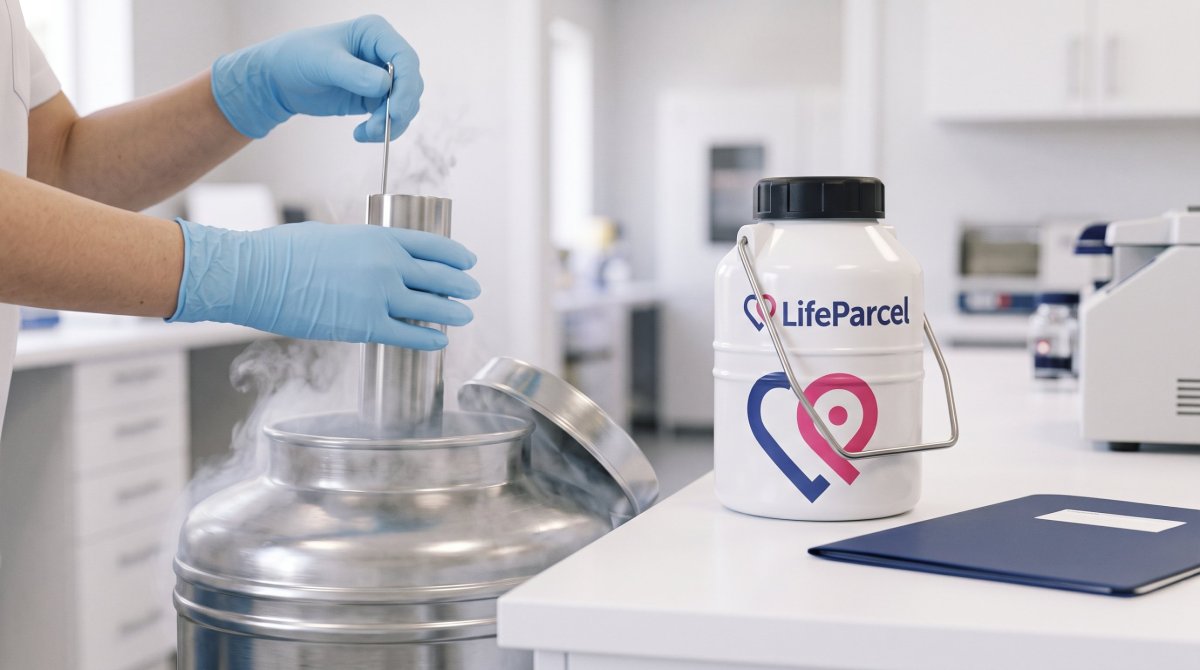


To ship sperm internationally for IVF, the sperm is first frozen and banked at a licensed clinic or sperm bank, then released to a receiving clinic abroad that has agreed to accept it. It travels in a dry shipper at -196°C, ideally hand-carried by a trained courier. Most of the work is paperwork and timing, not the flight itself.
This guide is for couples who live apart, partners who travel or are deployed abroad, and anyone whose sperm is frozen in one country but needed in another. It focuses only on international sperm transport.
When do people ship sperm internationally?
People ship sperm internationally when the person providing the sample and the clinic doing treatment are in different countries.
Common situations include:
- A partner working abroad. One partner lives or works overseas while treatment happens at home.
- Treatment in another country. A couple chooses an IVF clinic abroad, but the sperm is already banked at home.
- Relocation. Sperm was frozen years ago, and the family has since moved to another country.
- Fertility preservation. Sperm banked before medical treatment now needs to reach a clinic in a new country.
- Surrogacy. Intended parents need sperm delivered to a clinic where their surrogate is being treated.
For surrogacy-specific planning, see our complete guide to embryo transport for surrogacy abroad.
Step 1: Bank the sperm at a licensed facility
Before sperm can travel internationally, it must be frozen and stored at a licensed fertility clinic or sperm bank that can release it to another lab.
If the sperm is not yet frozen, the partner providing it will usually give a sample at a clinic near where they live. The lab freezes it in straws or vials and stores it in liquid nitrogen.
Tips for banking with transport in mind
- Tell the clinic it will be shipped abroad. This helps them prepare the right records and packaging.
- Ask what testing the receiving clinic needs first. Some tests must be done at the time of the sample or within a set window, and redoing them later can be difficult.
- Ask how the sample will be labeled. Clear, matching labels and records make acceptance easier at the other end.
Step 2: Get acceptance from the receiving clinic
The receiving clinic must agree in writing to accept the sperm before anything moves, and it will set most of the requirements.
Contact the clinic abroad early. Ask them for a full list of what they need. Requirements differ widely between clinics and countries.
Documents the receiving clinic may ask for
Every clinic is different, but common requests include:
- Infectious disease screening results, often with dates
- Consent forms signed by the sperm provider
- Identification documents
- Lab records describing the freezing method, number of vials or straws, and sample quality
- Proof of the relationship between partners, in some places
- Translations of documents, if the languages differ
Some clinics need test results from within a specific time period before use. Ask about this early, so testing is done at the right moment.
Step 3: Check import approvals
Import rules for sperm vary by country, and some countries require a permit or approval from a health authority before reproductive material can enter.
In some places, the receiving clinic handles the import application. In others, the patient must apply. Either way, LifeParcel can help you obtain the approvals your route needs. Some countries also limit who can use imported sperm or how it can be used.
The export side can matter too. The sending clinic may need specific documents before it will release material to another country. Rules change, so confirm everything with both clinics and, where legal questions arise, a reproductive attorney.
For more on preventing border problems, read how to prevent IVF shipping customs nightmares. LifeParcel has never had to open a tank at customs, and having the right documents ready is a big part of that.
Step 4: Decide how many vials to send
How many vials or straws to send is a decision for you and your clinic, based on how many treatment attempts you may need and what you want to keep in reserve.
There’s no single right answer, but here are questions worth discussing with your doctor:
- How many vials might a single IVF or ICSI cycle use with this sample?
- If the first cycle doesn’t work, will you want more sperm available abroad?
- Do you want to keep some vials at the original location as a backup?
- Is it easier to send everything at once rather than arrange a second shipment later?
Some families send all their vials together to avoid a second international transfer. Others keep a portion behind in case plans change. A single dry shipper can typically carry multiple vials, but your clinic will advise on what fits your treatment plan. This is not medical advice; talk it through with your fertility team.
Step 5: Time the shipment with the partner’s cycle
The sperm should arrive at the receiving clinic before treatment begins, not on the day it’s needed.
When sperm is used in IVF, the egg retrieval date depends on how the partner responds to stimulation medication. That date can shift by a few days. Because frozen sperm can be stored safely once it arrives, it’s best to deliver it ahead of time.
A practical timing approach
- Confirm acceptance and any import approval first.
- Plan delivery before the partner starts stimulation, or as early in the cycle as the clinic recommends.
- Leave room for paperwork delays and flight changes.
- Let the receiving lab confirm that the sperm has been checked in and stored.
A typical LifeParcel mission takes 3-4 days door to door. Our dry shippers hold -196°C for up to 21 days, which gives a wide safety margin. We don’t run missions on Saturdays (Shabbat), so pickup and delivery are scheduled around that.
Hand-carry vs cargo for international sperm transport
Hand-carry keeps one trained person with the dry shipper for the whole journey, while cargo shipping passes the tank through several networks and handlers.
In commercial cryoshipping, a tank is sent as cargo through courier and air-cargo networks. It may sit in warehouses, change hands several times and face screening along the way. On international routes with connections and customs checks, those handoffs add up.
What hand-carry changes
- One dedicated courier per mission keeps the shipper in sight from pickup to delivery.
- No X-ray. Specimens are never put through X-ray screening. Learn more about what happens when you X-ray fertility specimens.
- 24/7 GPS and temperature logging, with a temperature report available on request.
- Someone to answer questions at customs, with the documents in hand.
To understand how the container itself works, read about the liquid nitrogen dry shipper and how it protects your materials.
An illustrative example
Here is a generic scenario to show how the pieces fit, not a real client story.
Imagine one partner working in Europe while the other is having IVF at a clinic in the US. The partner abroad banks sperm at a local clinic and completes the infectious disease testing the US clinic requested. Both clinics confirm the paperwork, the US clinic issues written acceptance, and the sperm is hand-carried to the US lab a few weeks before stimulation begins. When retrieval day comes, the sperm is already stored and waiting.
Why families choose LifeParcel
LifeParcel is an embryologist-owned hand-carry courier, founded by embryologist Aharon Peretz, that specializes in moving reproductive material between clinics.
We bring 15+ years of experience and 3,200+ missions across 32+ countries on 5 continents. We work with 150+ partner clinics. Because our team understands lab workflows, we coordinate directly with embryologists at both ends.
Price depends on the route and distance, timing, paperwork and permits, each clinic’s requirements and the number of shippers. To get started, request a quote.
Frequently asked questions
Can I mail frozen sperm overseas myself?
No. Frozen sperm must stay at cryogenic temperature and move between licensed labs. Clinics release it only to an approved courier, and most countries have rules about importing reproductive material.
Do I need a permit to ship sperm internationally?
It depends on the destination. Some countries require an import permit or health authority approval, and others don’t. Rules vary and change, so confirm with the receiving clinic and, if needed, a reproductive attorney.
How early should sperm arrive before an IVF cycle?
Ideally before stimulation starts, so the retrieval date isn’t tied to a flight. Your clinic will tell you its preferred timing. Find more answers on our FAQs page.
Will the sperm be X-rayed at the airport?
Not with LifeParcel. Our couriers keep specimens out of X-ray screening throughout the journey.
If your sperm is in one country and your treatment is in another, we can help you bring them together. Send us your route and timing, and we’ll reply with a quote within 24 hours.
Follow LifeParcel on LinkedIn for fertility transport insights, mission stories and updates from our team.