



If you are planning to move embryos to another clinic, one of the first questions on your mind is probably the simplest one: how much will this cost?
It is a fair question, and you deserve a clear answer. The honest one is that there is no single price for embryo transport. Every mission is different, and the cost depends on a handful of very specific factors: where your embryos are, where they need to go, how quickly, and what each country and clinic requires along the way.
This guide walks you through those factors one by one, so you understand what goes into a quote, what to ask any transport provider, and how to get an accurate, personalized price for your own mission.
Why there is no one-size-fits-all price
Moving embryos is not like sending a parcel. Your embryos are stored at around -196°C, and they need to stay at that temperature, under an unbroken chain of custody, from the moment they leave your current clinic until they are safely stored at the new one. The route, the paperwork and the timing are planned around that single goal.
That is why two missions that look similar on paper can be priced quite differently. A transfer between two clinics in the same region involves very different logistics from a journey across several borders and time zones.
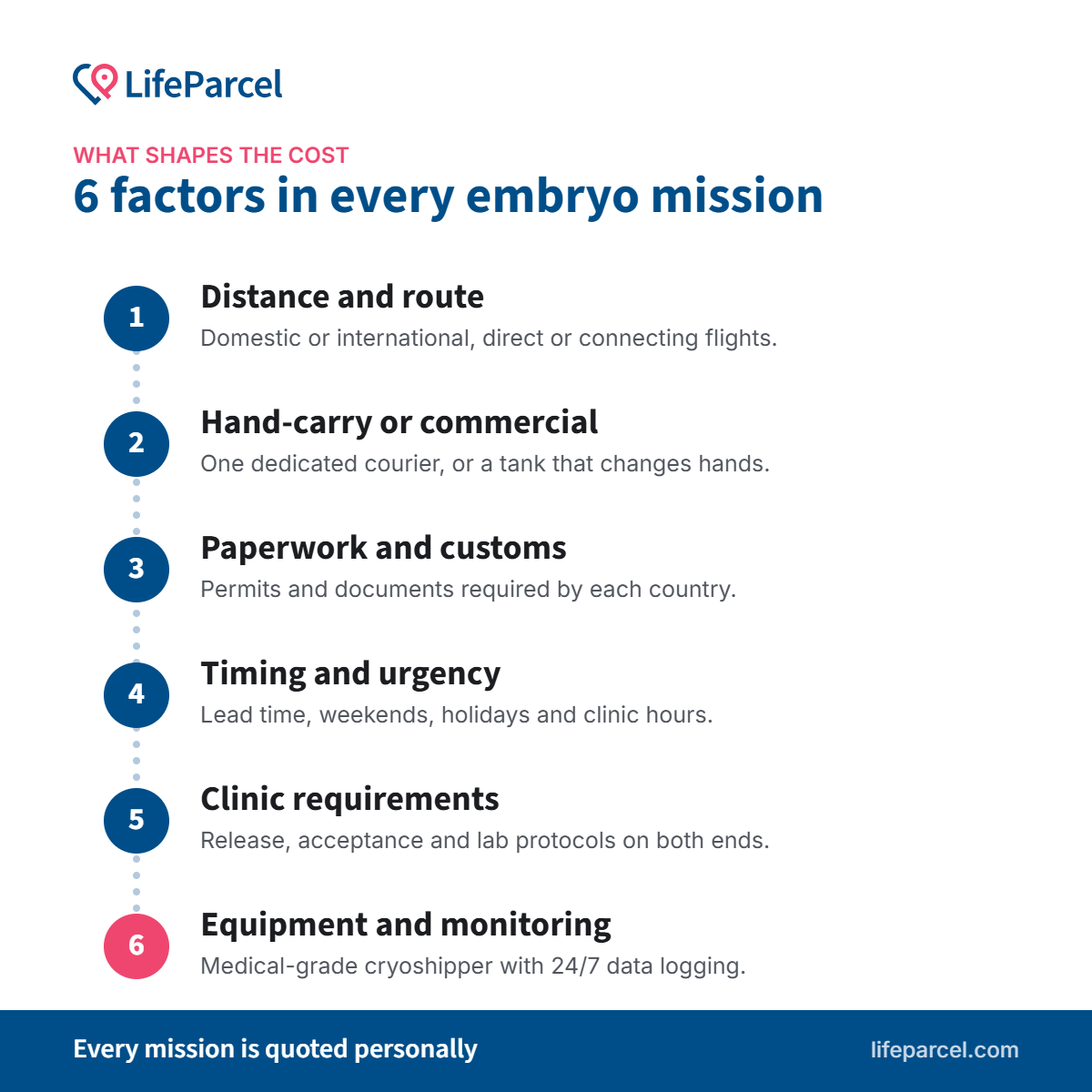
1. Distance and route
The starting point and destination are the biggest drivers of cost. A domestic mission is simpler than an international one, and a direct route is simpler than one with connecting flights. The number of flights, layovers and ground transfers all shape the time your courier spends traveling with the tank, and that time is part of what you are paying for.
2. Hand-carry or commercial shipping
How your embryos travel makes a real difference. With commercial cryoshipping, a specialist company sends the tank as a shipment through courier and air-cargo networks, and it changes hands along the way. With a hand-carry courier, one dedicated person travels with your embryos from pickup to delivery and never lets the tank out of sight.
Hand-carry includes the courier’s travel and time, so it reflects a higher level of personal responsibility. It also removes many of the risks that come with handoffs, X-ray screening and delays at unattended facilities. If you are weighing the two options, our article on hand-carry vs. standard shipping explains the differences in detail.
3. Paperwork, permits and customs
Every country has its own rules for importing and exporting reproductive material. Some destinations require import permits, specific medical documentation or advance approvals, and the requirements can change. The more documentation a route involves, the more coordination your mission needs before anyone picks up the tank.
Planning this well is what prevents delays at the border. Our guide on how to prevent IVF shipping customs problems covers what usually goes wrong and how to avoid it.
4. Timing and urgency
When you need your embryos to arrive matters. A mission planned weeks in advance gives everyone time to align schedules, book the best route and prepare documents. An urgent request, or a delivery that has to fit around weekends, holidays or narrow clinic hours, can require more complex planning.
The simplest way to keep your mission straightforward is to start early. As soon as you know you will be moving your embryos, it is worth reaching out to both clinics and to your transport provider.
5. Clinic requirements on both ends
Your sending and receiving clinics each have their own procedures: release forms, acceptance forms, pickup windows, delivery hours and lab protocols. Some clinics need more lead time than others, and some have specific requirements for how material arrives. Coordinating both sides is part of every mission, and it is one of the reasons quotes are personalized.
6. Equipment and monitoring
Embryos travel in a medical-grade dry shipper, a container pre-charged with liquid nitrogen vapor. At LifeParcel, our cryoshippers hold -196°C for up to 21 days, far longer than a typical 3–4 day mission, and every tank is fitted with a data logger that records the temperature 24/7. This equipment, and the monitoring that comes with it, is a core part of keeping your embryos safe. To learn more, see how fertility material shipping containers work.
What to ask any provider before you compare quotes
Quotes are only comparable when you know what is inside them. Before you decide, it is worth asking every provider the same questions:
- What exactly is included? Courier travel, equipment, temperature monitoring, documentation support and customs clearance should all be clear in advance.
- Who will physically carry the tank? One dedicated courier, or several handlers along the way?
- Will the tank go through X-ray screening? Here is why that question matters.
- What happens if there is a delay? Ask how long the shipper holds temperature and what the contingency plan is.
- Who keeps you updated? Will you have a single point of contact throughout the mission?
A lower number on a quote can look appealing, but it is worth understanding what you would be giving up. When the material inside the tank represents years of treatment, the details of how it travels matter more than anything else.
How to get an accurate quote
The fastest way to get a clear price is to share a few details up front. When you request a quote, it helps to have:
- The name and location of your current clinic or storage facility
- The name and location of the receiving clinic
- What is being transported (embryos, eggs or sperm)
- Your preferred timeline, and any dates that are fixed
- Any documents or requirements your clinics have already mentioned
With this information, our team can plan your route, check the requirements on both ends and prepare a personalized quote that reflects your actual mission, with no guesswork.
What every LifeParcel mission includes
LifeParcel was founded by embryologist Aharon Peretz, so the people planning your mission understand the science as well as the logistics. Every mission includes:
- A dedicated, vetted courier who hand-carries your embryos from pickup to delivery
- Medical-grade cryoshippers holding -196°C for up to 21 days
- 24/7 temperature monitoring with data loggers
- No X-ray exposure
- Support with permits, paperwork and customs clearance
- Coordination with both clinics
- A dedicated concierge who keeps you informed throughout
Our couriers have completed more than 3,200 missions across 32+ countries. Cold in our tanks, never in our approach.
Frequently asked questions
Why don’t you publish a price list?
Because every mission is different. The route, the countries involved, the clinics’ requirements and the timing all change what a mission needs. A personalized quote is the only way to give you a price that reflects your situation.
Is international embryo transport more complex than domestic transport?
Usually, yes. International missions often involve longer travel, more documentation and customs clearance, so they need more planning. That said, with the right preparation, international transport is a routine part of what we do.
Can I reduce the cost by planning ahead?
Planning ahead gives you more flexibility with routes and timing, and it reduces the chance of last-minute changes. Starting the process early is one of the most helpful things you can do for a smooth mission.
Is the cheapest option good enough?
It depends on what is included. Before choosing, check who carries the tank, whether it will be X-rayed, how temperature is monitored and what happens in case of a delay. These details are what protect your embryos.
How do I get a quote from LifeParcel?
Fill out our short quote form with your clinic details and timeline, and our team will prepare a personalized quote for your mission. If you are not sure about some of the details yet, that is fine: we will help you figure them out.
Get a personalized quote for your mission
Tell us where your embryos are now and where they need to go, and we will prepare a clear, personalized quote with everything your mission includes. Request a quote and a member of our team will be in touch.
Follow LifeParcel on LinkedIn for fertility transport insights, mission stories and updates from our team.